
OPTIMJACK: Optimizely Flaw Abused to Inject Crypto Clipper, Card Skimmer and iOS Exploit Kits Into 178+ Major Websites
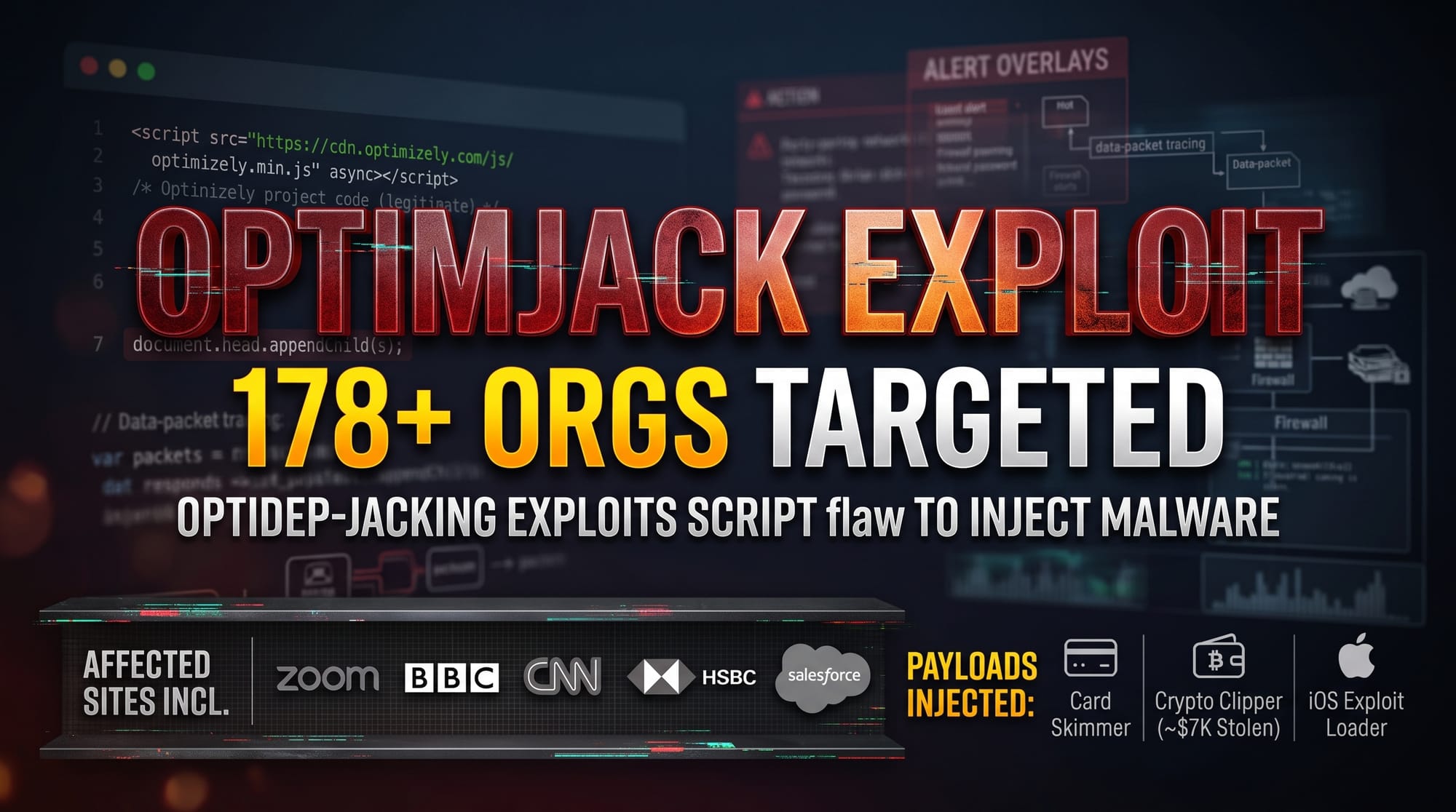
An attacker exploited a flaw in Optimizely Web Experimentation to plant malicious code in scripts that customers’ websites load from the service, Optimizely said early today. According to Report URI, a firm that monitors the scripts websites run, visitors to sites run by at least 178 organizations, including CNN, the BBC, and Zoom, received the code on Monday, November 16. Some researchers call the campaign OPTIMJACK.
The code was built to replace crypto wallet addresses with the attacker’s own and to capture card details. On iPhones and iPads, it was also set up to load a second stage that Report URI identifies as an iOS exploit kit, though it reports no iPhones actually being taken over. Optimizely says it has fixed the flaw and removed the code.
Optimizely’s statement
In an incident notice posted at 01:02 UTC, Optimizely said the attacker had exploited a vulnerability in Experimentation and used it to add malicious JavaScript to some customer projects. The vendor has also secured affected user accounts and added protections to stop unauthorized code from being delivered.
The notice does not say:
- How the flaw worked
- How many projects were changed
- When the fix went in
- Whether the attacker still has any access
- What customers should do
Report URI said Smartsheet’s script was cleaned once and then re-infected with a hidden version of the code, which shows the attacker still had access at that point. Before the notice appeared, the firm said it didn’t know how the attacker got write access to so many unrelated customer projects, and that this was for Optimizely to explain.
How the attack worked
Sites that use Optimizely to run experiments on their pages load a script from the vendor called a snippet. The snippet updates itself whenever the customer changes a setting, and each time it loads, it runs a field of custom code called Project JavaScript.
The attacker wrote a loader into the Project JavaScript of customer projects and left the rest of each snippet untouched. The snippets were still served from cdn.optimizely.com with the vendor’s own certificate, so every page that loaded one also ran the loader. Sites that serve the snippet from their own domain were affected too, because the content comes from the same project.
The loader came in three versions:
- Most snippets loaded
1688360[.]cc/track.jsdirectly. - One version hid that address in base64, so a text search for the domain would miss it.
- Another carried a full copy of the payload, which runs if the domain is blocked.
Cynet, whose endpoint detection flagged browser connections to the attacker’s server, traced the loader to a file served from cdn.optimizely.com and captured the code on CNN and Zoom pages. Cynet notes that a site that delivered the code has not necessarily had its own systems compromised.
Scale
Report URI checked 1,611 Optimizely snippets, mostly found through its own crawl data, and found the code in 188 of them, belonging to 178 organizations. It says the real number is likely higher, because it could only check the snippets it found in time.
Affected organizations include CNN, the BBC, Zoom, Salesforce, GitLab, IKEA, HSBC, Equifax, Air France-KLM, Ledger, and Peacock, among others. Optimizely’s own main site and login page also carried the code. Report URI’s post lists all 178 organizations and their domains.
Timeline (UTC)
| Date / time | Event |
|---|---|
| September 17 | The same actor’s injector (webshell[.]lol) first appears on Turkish sites |
| Late last week | Injector planted through Kissmetrics, StorifyMe, and Minute Media scripts |
| Monday 04:21 | First Optimizely injection seen, in the BBC’s snippet, loading webshell[.]lol |
| Monday 13:43 | Card skimmer added |
| Monday 17:13 – 17:57 | Coruna iframe added to every visit from iOS 18.6 or earlier |
| Monday 19:25 | Attacker’s wallets have received about $7,040 |
| Monday ~20:40 | Mass cleanup begins |
| Monday 21:52 | Only TalkTalk’s snippet still carries the code |
| Tuesday 01:02 | Optimizely posts its incident notice |
What the payload does
Crypto clipper
The payload, a file called track.js, replaces valid crypto wallet addresses with the attacker’s in page text, forms, links, the clipboard, and outgoing requests. According to StepSecurity, it only swaps an address that passes its chain’s checksum and sits near a payment word such as wallet, deposit, or send. Copying isn’t safe either: an address a visitor copies from one of these pages may already be the attacker’s by the time it’s pasted into a wallet.
Card skimmer
Added at 13:43 UTC, the skimmer captures the card number, expiry date, and CVV when they are submitted through the site’s form fields, and sends them to the attacker’s server. It cannot read cards entered in a cross-origin payment iframe, such as Stripe’s hosted fields or Adyen’s. Report URI cannot see how many card numbers were exposed.
Cookies and screenshots
Only after swapping an address near wallet or payment wording does the code send the visitor’s cookies and a screenshot of the page to the attacker. It cannot read cookies marked HttpOnly.
iOS exploit kits
On iPhones and iPads, the code loads a script called boot.js from two .icu domains. It reads the iOS version and opens an exploit chain in a hidden iframe:
| iOS version | Exploit chain |
|---|---|
| iOS 13 – 17 | Coruna (targets iOS 13.0 to 17.2.1) |
| iOS 18 | DarkSword (targets iOS 18.4 to 18.7) |
| iOS 26 | A separate chain that so far only collects device details |
Report URI identifies Coruna and DarkSword as exploit kits documented by Google researchers. Pages with the Coruna iframe reload every 60 seconds to retry the exploit, which visitors might notice. According to the firm, the kit’s own comments mark iOS 18.7.3 and later and iOS 26.3 and later as patched.
Cynet retrieved the second stage using an emulated iPhone browser. It describes what it saw as conditional delivery, not a successful compromise of a physical iPhone or iPad.
Crypto already stolen
Report URI says that as of 19:25 UTC on Monday, the attacker’s wallets had received about $7,040, all within roughly nine hours. StepSecurity put the total across the same addresses at about $6,600. It noted that two of the addresses were in use before the injections began, and that the blockchain doesn’t show which transfers came from victims.
What site owners should check
Report URI recommends:
- Open the Project JavaScript in every project and the custom code in every experiment, and look for
1688360,atob(, or any script you didn’t write. Theatob(check finds the base64 version of the loader. - Review which users, API tokens, and integrations can write to your account, and rotate their credentials.
- If your own forms take card details, treat cards entered on Monday as possibly exposed.
- Treat session tokens or other secrets in cookies without the HttpOnly flag as exposed, and rotate them.
- Deploy a Content Security Policy with strict
script-srcandconnect-src. Allowing cdn.optimizely.com doesn’t help, because the code came from that host, andstrict-dynamicorunsafe-evallet the payload run on some sites. - Consider telling your customers that your site served them the code.
Report URI kept a copy of every infected snippet, with hashes and timestamps, and can share them with affected organizations and CERTs on request.
StepSecurity also advises:
- Block the indicators below, and search logs back to 08:00 UTC on Monday.
- Fetch every snippet you serve, search it for
1688360,.icu, andtrack.js, and record its Last-Modified header. - Ask Optimizely which of your project IDs were changed, and when and how.
- Keep third-party tags off checkout pages, and take card details through the payment provider’s own fields in a cross-origin iframe.
- Replace any card entered on an affected site on Monday, and check wallet addresses on a hardware wallet’s screen rather than against copied text.
- Consider having iPhones and iPads on iOS 18.6 or earlier that visited affected sites checked for signs of compromise.
A snippet that is clean now may still have served the code on Monday.
Cynet treats cdn.optimizely.com as a legitimate delivery host, not an indicator, and advises against broadly blocking that host or the affected news sites.
What visitors should do
Report URI advises anyone who visited an affected site on Monday to:
- Update iPhones and iPads to iOS 18.7.3 or later, or iOS 26.3 or later.
- Compare any crypto payment made that day with the address you meant to pay. If they differ, the address may have been swapped.
- Watch your card statements if you paid by card on one of the sites.
Indicators of compromise
The payload changed several times during the day, so a single file hash won’t catch every version.
| Type | Indicator | Context |
|---|---|---|
| Domain | 1688360[.]cc | Payload host (paths: /track.js, /card.php, /hit.php) |
| IP | 136.113.106[.]136 | Address 1688360[.]cc pointed to |
| Domain | 5vobauua3ojpklx[.]icu | iOS stage |
| Domain | eil786npto9u5bq[.]icu | iOS stage |
| Domain | webshell[.]lol | Injector loaded by the first injection (04:21 UTC Monday) |
| SHA-256 | f7b84b9a94f749f8ced3f0112d0a66894e8bbc3b4aa5592021d1b8976a9bad40 | Final version of track.js |
| SHA-256 | 617df364120adc47fb4f55dcc0c69a9b6c9e108a92c60bc2b64a266254ab02f3 | Earliest captured version of track.js |


